
Choosing Architectural Aluminum Decorative Trims for Lasting Facade Performance
Architectural aluminum decorative trims have become a default choice wherever a building envelope needs a clean edge, a protected corner, or a visible seam that still looks intentional. Designers reach for them because raw joints weather unevenly, and unfinished edges invite moisture, impact damage, and a cheap-looking result over time. The right trim profile solves that quietly, which is exactly why it gets specified so often on facades, lobbies, and curtain wall transitions.
Why Builders Keep Running Into Trim Problems
Most trim failures trace back to one of three causes: the wrong alloy for the exposure, a profile shape that can't handle thermal movement, or a finish that wasn't matched to the environment. Coastal projects corrode trims that weren't rated for salt exposure. Northern climates crack finishes that couldn't flex with freeze-thaw cycles.
A trim that looks identical to a better-engineered one on a spec sheet can behave very differently after five years outdoors. That gap usually isn't visible until the warranty period is already over, which is why specification decisions made early carry more weight than they seem to at the time.
What Makes Aluminum the Default Material Here
Aluminum earned its place in trim applications for reasons that have little to do with trend and more to do with physics. It resists corrosion naturally through its own oxide layer, it's light enough to install without heavy structural backing, and it extrudes into tight, repeatable profiles that steel or PVC can't match at comparable cost.
Unlike painted steel, aluminum doesn't rely entirely on its coating to stay rust-free. If a coating gets scratched during installation or years later during maintenance, the aluminum underneath forms a protective oxide layer that prevents further degradation. That's a meaningful difference on a trim that sits at a corner where carts, ladders, or foot traffic are likely to make contact eventually.
How Extrusion Shapes What's Possible
Decorative trim profiles are made through precision extrusion, where heated aluminum alloy is pushed through a shaped die to form a continuous length with a consistent cross-section. This process is what allows a single design to be reproduced across hundreds of meters without variation in wall thickness or edge geometry.
The practical upside for a design team is flexibility. Instead of selecting from a narrow catalog of stock shapes, extrusion makes it feasible to develop a custom profile for edge finishing, corner protection, or a decorative transition strip that matches a specific detail drawing. Youxin Metal's aluminum decorative trim line, for example, is offered through custom profile development, cutting, finishing, and packaging as a single workflow, rather than treating each step as a separate vendor relationship.
Matching Trim Shape to the Actual Job
Not every trim does the same job, even though they can look similar from a distance. Before specifying a profile, it helps to separate the function from the aesthetic:
- Edge finishing trims cap raw panel edges to prevent sharp corners and hide cut lines on wall or ceiling panels.
- Corner protection profiles absorb impact at vulnerable building corners, often in high-traffic lobbies or loading areas.
- Decorative transition strips bridge two different materials, such as flooring changes or panel-to-panel junctions, where a visible seam needs to look deliberate.
- Structural trim frames support furniture edges or industrial assembly line components where rigidity matters as much as appearance.
Picking the wrong category for the application is a common misstep. A decorative transition strip rated for light foot traffic won't hold up as corner protection in a loading dock, even if the finish and color look like a perfect match on paper.
Surface Finishing Options and Where Each One Fits
The alloy does the structural work, but the finish is what determines how the trim ages visually. Surface treatment choice should follow the exposure conditions, not just the color palette on a moodboard.
| Finish Type | Typical Use Case | Key Consideration |
|---|---|---|
| Anodized | Exterior facades, high-UV exposure | Hard oxide layer resists fading and abrasion |
| Powder Coated | Interior and exterior accents | Wide color range, good chip resistance |
| PVDF | Long-term exterior cladding trims | Strong resistance to chalking and color shift |
| Electrophoretic | Interior trims, moderate exposure | Smooth, uniform coating with good edge coverage |
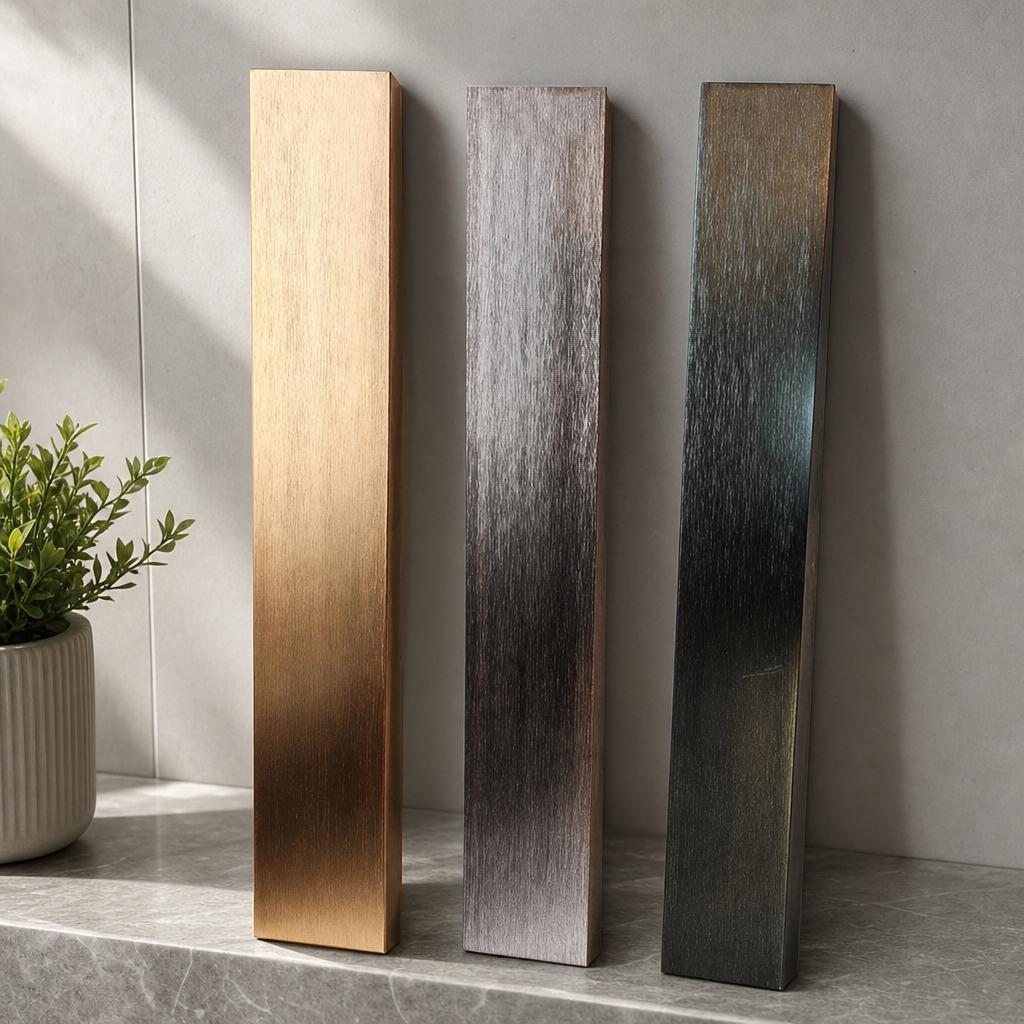
| Wood Grain | Interior decoration, furniture edges | Mimics timber look without wood's moisture sensitivity |
Anodizing suits facades that take direct sun for most of the day, since the oxide layer is part of the metal rather than a film sitting on top of it. PVDF coatings tend to be the choice for cladding trims that need to hold color over many years outdoors. Wood grain finishes solve a different problem entirely: designers who want a timber aesthetic without timber's susceptibility to warping, insects, or moisture absorption.
Thin-Wall Profiles and Why Tolerance Matters
Modern facade and furniture details increasingly call for slimmer trim profiles that don't visually compete with the surface they're finishing. Producing a thin-wall aluminum section without warping or inconsistent wall thickness requires tight die control and extrusion press capacity suited to the alloy being used.
Fabricators working with heavier-tonnage presses have more flexibility to hold tolerance across thinner sections, which matters when a trim profile needs to stay flat across a long run instead of showing waviness once it's installed under lighting. This is less about marketing a number and more about avoiding the real-world problem of a trim that looks fine in a sample box but telegraphs every imperfection once it's mounted on a wall.
Where These Trims Actually Get Used
Decorative aluminum trims show up across a wider range of projects than their name suggests. Common applications include:
- Architectural facades and building envelope detailing, where trims finish panel joints and parapet edges.
- Interior wall and ceiling systems, where trims hide fastener lines and panel seams.
- Furniture manufacturing, where edge trims protect panel corners on tables, cabinetry, and shelving.
- Industrial assembly frames, where lightweight aluminum trim sections form lightweight structural borders.
- Flooring transitions, where trims manage the height difference between two different floor materials.
Each of these scenarios asks something different of the trim. Facade applications prioritize UV and weather resistance. Furniture applications prioritize finish consistency and tactile edge quality. Recognizing which priority applies to a given project before ordering avoids the mismatch between spec sheet and site performance mentioned earlier.
Working With a Fabricator on a Custom Profile
Custom trim profiles start with a die, and the die determines nearly everything downstream, from tolerance to lead time. A fabricator with in-house extrusion capacity can usually iterate on a profile drawing faster than one that outsources extrusion and only handles finishing. When evaluating a potential supplier, a few questions tend to separate a smooth project from a frustrating one:
- Can they produce the wall thickness your detail requires without excessive scrap rate?
- Do they offer the specific finish your exposure condition calls for, in-house rather than through a third party?
- Is cutting, finishing, and packaging handled as one coordinated process, or does the project pass through multiple disconnected vendors?
For us, profile development, extrusion, surface finishing, and packaging are handled under one roof, which shortens the feedback loop when a sample needs adjusting before full production.
Frequently Asked Questions
Does anodized aluminum trim need any ongoing maintenance?
Routine cleaning with mild soap and water is typically enough. Anodized finishes don't require periodic resealing the way some painted surfaces do, though harsh abrasive cleaners should still be avoided.
Can aluminum trim be used alongside steel framing without corrosion issues?
Direct contact between aluminum and certain metals can cause galvanic corrosion in damp conditions. Using an isolating gasket or appropriate barrier at the connection point avoids this problem.
Is wood grain finished aluminum trim as durable as painted aluminum outdoors?
Wood grain finishes are generally positioned for interior or moderately exposed applications. For harsh exterior exposure, PVDF or anodized finishes are the more established choice.
What's the difference between powder coating and PVDF for exterior trims?
Powder coating offers a broad color selection at a lower cost but may chalk or fade faster under prolonged UV exposure compared with PVDF coatings, which are formulated specifically for long-term exterior color retention.
Choosing the right architectural aluminum decorative trims comes down to matching alloy, profile shape, and finish to the actual conditions a project will face, rather than selecting on appearance alone. A trim that handles coastal salt exposure, resists corner impact in a busy lobby, or holds its color through a decade of sun exposure isn't a different product category. It's the same aluminum decorative trim category, specified correctly from the start. Getting that specification right the first time, with a fabricator capable of custom profile development and finishing in one process, saves far more in avoided callbacks than it costs in upfront planning.
Related_News
-

Aluminum craftsmanship, a new chapter begins – Eugene Metals' New Year's greeting for 2026
-
Aluminum ingot prices continue to rise, and factories are flexibly adjusting their production capacity to cope with market fluctuations.
-
Aluminum Corrugated Panel: Choosing the Right Wave Profile for Facades and Interiors
-
Aluminum Trim Profiles: A Practical Guide to Finishing and Edge Protection
-
Aluminum Veneer Panel Guide: Profiles, Specs, and Uses
SUBSCRIBE
Find Your Ideal Aluminum Solution
INQUIRY