
Aluminum Corrugated Panel: Choosing the Right Wave Profile for Facades and Interiors
An aluminum corrugated panel looks simple from a distance. Up close, the wave geometry is doing structural work that a flat sheet never could. Architects and fabricators keep circling back to this format because it solves a specific tension: buildings need cladding that is light enough to install quickly but stiff enough to survive wind loads, thermal cycling, and years of weather. That tradeoff is why the corrugated profile exists in the first place, and why it keeps showing up on facades, ceilings, and partitions across very different climates.
This article breaks down what actually makes a corrugated aluminum panel perform, where the numbers matter for your project, and how to read a spec sheet without getting lost in jargon.
Why the Wave Shape Matters More Than the Alloy
Flat aluminum sheet bends under load the way a piece of paper does. Fold that same sheet into a series of ridges, and suddenly it resists bending along the corrugation direction almost like a small beam. This is basic structural geometry, not a coating or treatment. The ridges increase the panel's moment of inertia without adding material thickness, which is why corrugated aluminum panels can carry wind loads and self-weight over longer spans than an equivalent flat panel of the same gauge.
That single geometric trick is the reason corrugated panels show up in roofing and facade systems where flat sheet would need extra stiffeners or a thicker gauge. You get the rigidity gain, but the panel itself stays light.
There's a tradeoff worth knowing before you specify a profile. Deeper, sharper waves generally add more stiffness, but they also change how the panel reads visually and how it handles at the cut edges during installation. A shallow wave photographs almost like a subtle texture. A deep wave reads as a strong architectural line from across a parking lot. Neither is better; they solve different design problems.
What the Thickness Range Actually Tells You
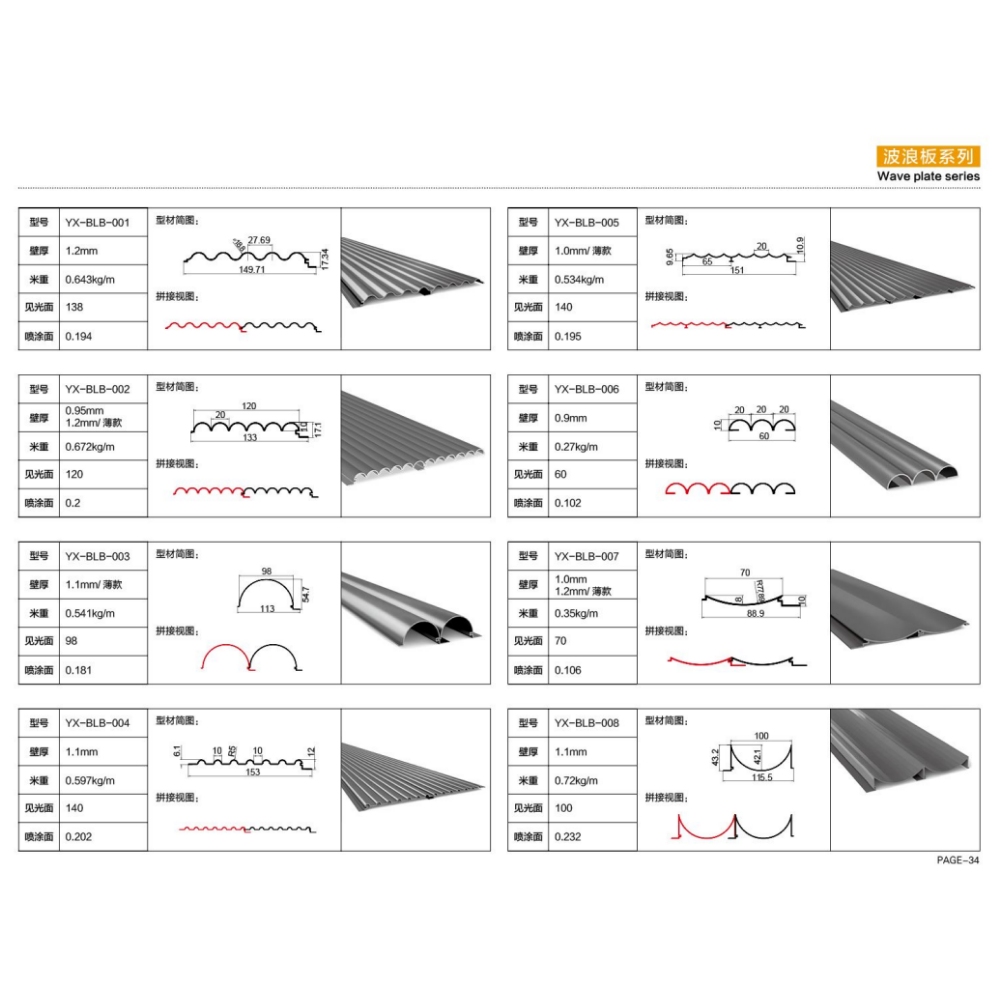
According to the product specifications, corrugated aluminum panels in this category typically run from 0.8mm to 3.0mm in thickness, with weights ranging roughly from 0.19kg per square meter up to 2.0kg per square meter depending on the profile and gauge selected. That's a wide spread, and it's not arbitrary. Thinner gauges suit decorative interior work where load isn't a real concern. Thicker gauges earn their place on exterior facades and roofing where wind uplift and impact resistance matter.
Here's a practical way to think about it:
| Use Case | Typical Thickness Direction | Why |
|---|---|---|
| Interior ceilings and partitions | Thinner end of range | Lower structural demand, easier handling |
| Decorative wall cladding | Mid-range | Balance of weight and rigidity |
| Exterior facades and curtain walls | Thicker end of range | Wind load, weather exposure |
| Roofing applications | Thicker end of range | Load-bearing and impact resistance |
None of this replaces a structural engineer's calculation for your specific span and load zone. But it gives you a starting conversation when you're comparing quotes that all list different gauges for seemingly the same panel.
Weight Savings Are Not Just a Shipping Line Item
Lightweight is one of those words that sounds like marketing filler until you've actually installed cladding on a mid-rise building. A lighter aluminum corrugated panel means fewer crew members needed per lift, less strain on the substructure and fixings, and lower freight cost per square meter shipped. On a large facade job, that weight difference compounds across hundreds of panels.
It also changes what the building can support. Retrofits on older structures are often limited by how much additional dead load the existing frame can take. A corrugated aluminum system, being lighter than many alternative claddings of similar visual weight, can sometimes be the deciding factor between a renovation being feasible or requiring structural reinforcement first.
Weather Resistance Comes From Two Different Things
People tend to lump "weather resistance" into one vague quality, but it's really two separate mechanisms working together.
- The alloy itself resists corrosion under normal atmospheric exposure, which is a baseline property of aluminum compared to uncoated steel.
- The surface finish applied on top determines how the panel holds its color and appearance under UV exposure, temperature swings, and wind-driven rain over years of service.
A panel can have excellent base corrosion resistance and still look faded or chalky after a few seasons if the surface treatment wasn't matched to the exposure conditions. That's why the finish spec deserves as much attention as the alloy grade when you're comparing suppliers. According to product documentation for this panel line, the surface treatment is engineered to maintain long-lasting color and appearance specifically for decorative exterior projects, which matters most on south-facing or high-UV facades where color drift is most visible.
Reading a Profile Chart Without Getting Lost
Spec sheets for corrugated panels usually list a series of model codes, each tied to a specific wave pitch, wave height, and wall thickness. It looks intimidating at first glance, but the logic is straightforward once you know what to look for.
- Wave pitch is the horizontal distance between ridge peaks. Tighter pitch usually reads as a finer texture; wider pitch reads as a bolder line.
- Wave height (sometimes called amplitude) is how deep the corrugation runs. Taller waves generally mean more stiffness per unit of material.
- Wall thickness is the actual metal gauge, independent of the wave shape.
- Weight per square meter is the number that actually matters for structural calculations and shipping quotes, since it accounts for both thickness and profile geometry.
When two panels list the same thickness but different weights per square meter, the difference usually comes down to wave geometry, not a measurement error. It's worth asking your supplier to clarify rather than assuming the lighter one is simply thinner.
Where These Panels Actually Get Used
Corrugated aluminum panels aren't a one-application product. The same underlying geometry adapts across several very different settings:
- Building facades and exterior cladding, where weather resistance and structural rigidity both matter
- Architectural curtain wall systems, often combined with insulation cores for thermal performance
- Interior ceiling systems, where lighter gauges and decorative finishes take priority over structural load
- Decorative wall partitions in commercial interiors, retail, and hospitality spaces
- Commercial and industrial roofing, where load-bearing capacity and long-term weather exposure are the primary concerns
The common thread across all five is that the corrugation does double duty: it's a structural feature and a visual one at the same time. That's fairly unusual in building materials, where you usually pay a premium for either performance or aesthetics, rarely both from the same design choice.
Fabrication and Installation Considerations
Ease of maintenance and installation isn't just about the panel sitting in place quietly for a decade. It starts at the fabrication stage. Corrugated aluminum is generally easier to cut, form, and fasten than heavier cladding materials, which shortens installation time and reduces the specialized equipment a crew needs on site.
That said, corrugated edges do require attention during cutting and trimming. An improperly finished cut edge can become a starting point for corrosion or an aesthetic flaw at panel joints. Crews experienced with corrugated profiles typically use edge treatments or trim pieces specifically designed for the wave geometry, rather than the flat trims used on standard sheet cladding.
Frequently Asked Questions
Does a deeper corrugation always mean a stronger panel?
Generally, yes, deeper wave height improves stiffness along the corrugation direction. But strength also depends on wall thickness and how the panel is fastened to its substructure, so wave depth alone isn't the full picture.
Can corrugated aluminum panels be used indoors and outdoors on the same building?
Yes. It's common to use a thicker, weather-resistant gauge on the exterior facade and a lighter decorative gauge for interior ceilings or partitions, matching the panel to the actual load and exposure of each area.
Why do panels with the same thickness sometimes have different weights?
This usually comes from differences in wave pitch and wave height across profile models, which change how much material sits in a given panel area even at the same wall thickness.
Is corrugated aluminum more expensive to maintain than flat panels?
Based on the product's design intent, corrugated aluminum panels are engineered for straightforward fabrication and low-maintenance upkeep, which can reduce long-term operational costs compared to materials that require recoating or more frequent inspection.
Choosing a Supplier and Profile That Fit Your Project
Picking the right aluminum corrugated panel isn't about finding the single best profile. It's about matching wave geometry, thickness, and finish to the specific loads, climate, and visual intent of your project. A facade in a coastal, high-wind region has different priorities than an interior ceiling in a climate-controlled retail space, even though both might use panels from the same product family.
For us at Youxin Metal, that means offering a range of thicknesses from 0.8mm to 3.0mm and multiple wave profiles, so fabricators and architects can select a configuration suited to facades, curtain walls, ceilings, or partitions rather than forcing one profile to do every job. With extrusion capabilities down to 0.4mm gauge and a supporting surface treatment line, custom aluminum corrugated panel configurations can be adapted to project-specific structural and aesthetic requirements rather than limited to a fixed catalog size.
Getting this right upfront, during the specification stage, avoids the more expensive problem of discovering mid-installation that a chosen profile can't meet the span or load requirements of the actual building.
Related_News
-

Aluminum craftsmanship, a new chapter begins – Eugene Metals' New Year's greeting for 2026
-
Aluminum ingot prices continue to rise, and factories are flexibly adjusting their production capacity to cope with market fluctuations.
-
Aluminum Trim Profiles: A Practical Guide to Finishing and Edge Protection
-
Aluminum Veneer Panel Guide: Profiles, Specs, and Uses
-
Choosing the Right Aluminum Extruded Square Tube for Your Project
SUBSCRIBE
Find Your Ideal Aluminum Solution
INQUIRY